Navigating the Complexity of Digital Core Modernization for Enterprises
"A deep dive into the architectural challenges and strategic imperatives of modernising the digital core in global enterprises, focusing on legacy debt and cloud-native transitions."
Navigating the Complexity of Digital Core Modernisation for Enterprises
In the current epoch of relentless digital acceleration, the concept of a 'Digital Core' has transitioned from a supporting infrastructure role to the very heartbeat of enterprise agility. However, for many global organisations, this core remains shackled by legacy architectures, proprietary silos, and decades of accumulated technical debt. Modernising the digital core is not merely a technical upgrade; it is a fundamental re-engineering of how an organisation generates value, responds to market shifts, and leverages data as a strategic asset.
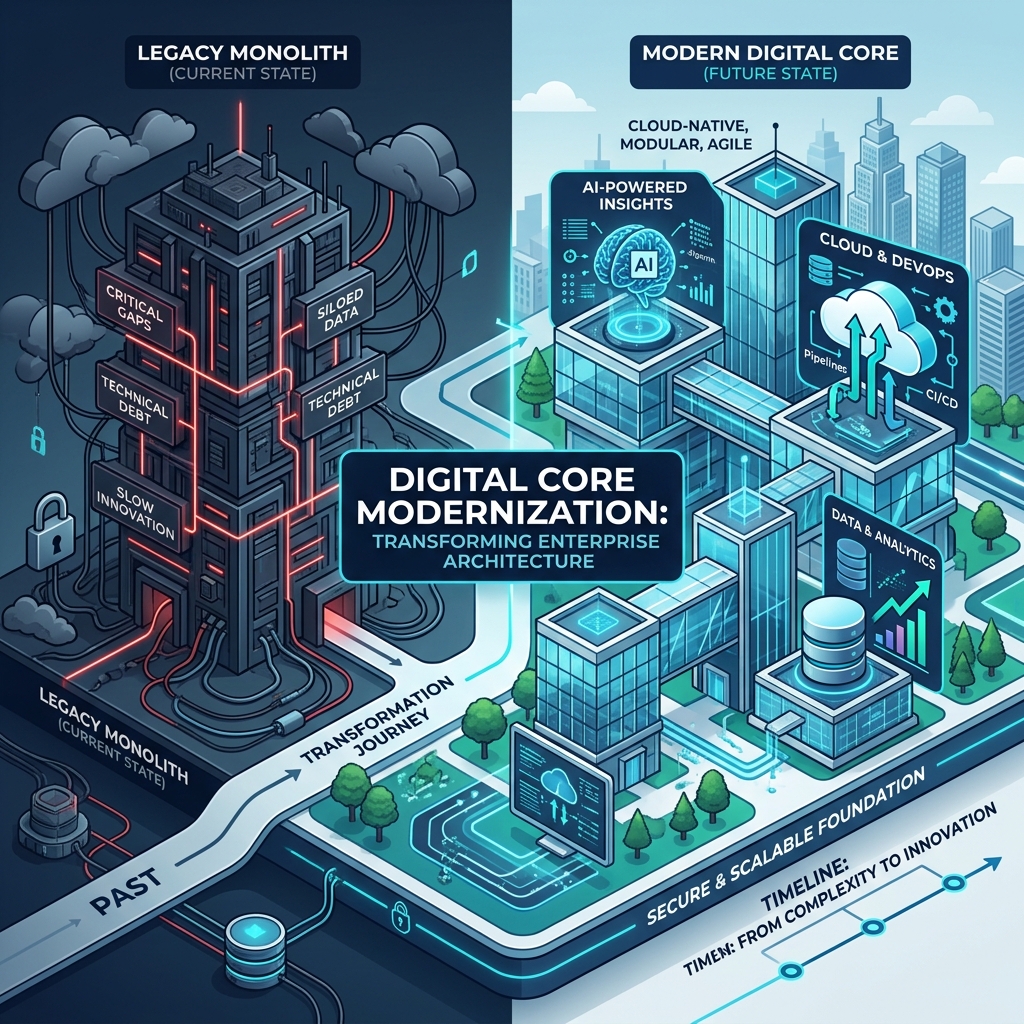
The Evolution of the Digital Core
The Architectural Challenge: Deconstructing the Monolith
The primary obstacle in core modernisation is the inherent complexity of legacy systems. These 'digital monoliths' were often built for a pre-cloud era, characterised by tight coupling between data and logic, and a lack of modularity. This architectural rigidity leads to 'Configuration Drift' and increasing maintenance overheads, where the majority of IT budgets are consumed by keeping the lights on rather than driving innovation.
From a Lead Architect's perspective, the challenge is twofold: maintaining operational continuity while simultaneously carving out a path toward a cloud-native, microservices-oriented future. This requires a nuanced approach to decoupling—frequently employing 'Strangler Fig' patterns to incrementally migrate functionality without disrupting critical business processes.
Strategic Imperatives: Beyond Re-platforming
Successful modernisation transcends simple 'Lift and Shift' methodologies. While re-hosting might offer immediate infrastructure cost savings, it fails to address the underlying inefficiencies of legacy code. At TAPOSYS, we advocate for a more comprehensive strategy that includes:
1. Application Re-Architecting
Transitioning to microservices allows for independent scalability and deployment. By using container orchestration platforms like Kubernetes, enterprises can ensure high availability and efficient resource utilisation. This shift also facilitates the adoption of DevOps and AIOps, where automated monitoring and self-healing systems reduce the burden on Infrastructure Management Services (IMS).2. Data Modernisation and Governance
A modern digital core depends on a unified, real-time data layer. Legacy silos prevent the effective use of AI and Advanced Analytics. Transitioning to modern data architectures, such as Data Lakes or Data Meshes on Azure, ensures that data is accessible, secure, and ready for RAG (Retrieval-Augmented Generation) and other AI-driven enterprise applications.3. FinOps and Cost Optimisation
Modernisation often leads to unpredictable cloud spending if not managed correctly. Implementing FinOps practices ensures that every dollar spent in the cloud is aligned with business value. This involves real-time visibility into usage, automated scaling, and rigorous governance to prevent resource leakage. At the enterprise level, this means moving beyond simple budgeting to a culture of 'Cloud Financial Accountability', where engineering teams are empowered to manage their own cloud unit costs through granular tagging and automated anomaly detection.The Role of AIOps in Sustaining Modernisation
As the digital core becomes more distributed and dynamic, manual infrastructure management becomes a bottleneck. This is where AIOps—AI for IT Operations—becomes indispensable. By leveraging machine learning models to analyse the vast telemetry generated by a modern core, organisations can move from reactive incident management to predictive maintenance.
At TAPOSYS, we integrate AIOps to solve the 'Alert Fatigue' problem. By correlating events across the stack—from network latency in Azure to application performance metrics in local clusters—we create a self-healing infrastructure. This automation ensures that 'Configuration Drift' is detected and remediated before it impacts the user experience, maintaining a high level of operational integrity that is essential for global-scale enterprises.
Scalability and Future-Proofing: The TAPOSYS Methodology
Scalability is not just about handling more users; it's about the ability of the architecture to evolve without a total rewrite. A well-modernised digital core uses open standards and interoperable frameworks to avoid vendor lock-in. Whether it's through the use of Terraform for Infrastructure as Code (IaC) or implementing robust OIDC authentication for secure CI/CD pipelines, every decision must be made with an eye toward the next decade of technology shifts.
Our approach at TAPOSYS Global IT Solutions LLP is rooted in 'Security-First Engineering'. We don't bolt security on as an afterthought; it is woven into the very fabric of the digital core. This proactive stance on governance and security, combined with our deep expertise in AI Engineering, allows our clients to innovate with confidence, knowing their foundation is both stable and state-of-the-art.
Navigating the Human Element and Cultural Shift
Technological change is often the easier part; the cultural transformation within the organisation is where many initiatives falter. Modernising the core requires a shift from 'Project thinking' to 'Product thinking'. It demands a commitment to continuous learning and an acceptance of iterative delivery. Engineering teams must be re-skilled to operate in a cloud-native environment, moving away from manual configurations to automated, code-driven infrastructure.
The Lead Content Developer's role here is to bridge the gap between technical complexity and business strategy. Clear communication of the 'why' behind architectural decisions—such as why a certain microservices pattern was chosen or how FinOps will impact the bottom line—is crucial for securing stakeholder buy-in and ensuring that the modernisation road-map remains aligned with long-term corporate objectives.
The TAPOSYS Perspective: A Phased Approach to Boutique Excellence
At TAPOSYS Global IT Solutions LLP, we don't believe in one-size-fits-all solutions. Our methodology for Digital Core Modernisation is bespoke, focusing on the specific pain points and strategic goals of our clients. Whether it's optimising Cloud Ops, engineering AI-driven workflows, or modernising Application Management Services (AMS), our focus remains on scalability, security, and performance. We pride ourselves on our 'A-Z' service spectrum, ensuring that no part of the digital journey is left to chance.
The journey to a modern digital core is a marathon, not a sprint. It requires a partner who understands the intricacies of both legacy systems and the cutting-edge of cloud-native engineering. By focusing on architectural integrity and operational excellence, enterprises can transform their digital core from a liability into a formidable competitive advantage.
Key Takeaway
Digital core modernisation is the foundation for all subsequent digital transformation efforts. Without a resilient, scalable, and modular core, initiatives in AI, IoT, and advanced analytics will inevitably struggle. Priority must be given to de-risking the transition through phased decoupling, robust data governance, and proactive FinOps management.
--- For more insights into bespoke enterprise transformation, explore our range of services from Cloud Engineering to AI Engineering at TAPOSYS Global.

The TAPOSYS Perspective
Our architecture-first methodology ensures that every digital transformation initiative is rooted in absolute scalability and long-term security. We don't just build systems; we engineer future-proof legacies.