Back to Insights Hub
16 Apr 2026Lead Architect
The Role of Agile Methodologies in Large-Scale Digital Transformation
AgileDigital TransformationSAFeEnterprise StrategyTAPOSYS
Architectural Summary
"Exploring how Agile frameworks address the complexities of global digital transformation, ensuring alignment between enterprise architecture and iterative delivery."
The Role of Agile Methodologies in Large-Scale Digital Transformation
In the high-stakes arena of enterprise-level digital transformation, the 'Big Bang' approach is increasingly viewed as a relic of an obsolete architectural era. As global organisations strive to modernise their Digital Core, the integration of Agile methodologies has transitioned from a development-centric preference to a strategic imperative. Large-scale transformation is no longer just about the technology; it's about the speed and flexibility with which that technology can be deployed, refined, and scaled.The Strategic Shift: From Rigid Planning to Iterative Agility
Traditional project management, characterised by long, sequential phases and fixed requirements, often leads to 'Project Drift' and 'Value Decay'. In a large-scale digital transformation, where the environment is constantly evolving, the rigidity of Waterfall methodologies can result in a digital core that is obsolete before it is fully deployed. Agile methodologies—specifically scaled frameworks like SAFe (Scaled Agile Framework) or LeSS (Large-Scale Scrum)—provide the necessary architectural runway to handle complex dependencies while maintaining the momentum of continuous delivery.Why Agile for Large-Scale Transformation?
1. Risk Mitigation through Incremental Delivery: By breaking down a multi-year transformation into two-week sprints or monthly increments, organisations can validate architectural decisions in real-time. If a specific cloud integration or AI model isn't performing as expected, the pivot occurs in weeks, not years. 2. Continuous Alignment with Business Goals: Agile ensures that the 'Digital Core' remains aligned with current market conditions. It bridges the gap between the Lead Architect's vision and the operational reality. 3. Enhanced Product Visibility: Through regular demos and stakeholder reviews, the transformation progress is transparent. This 'Product Visibility' is crucial for maintaining long-term executive support for high-budget initiatives.Architectural Integrity in an Agile Environment
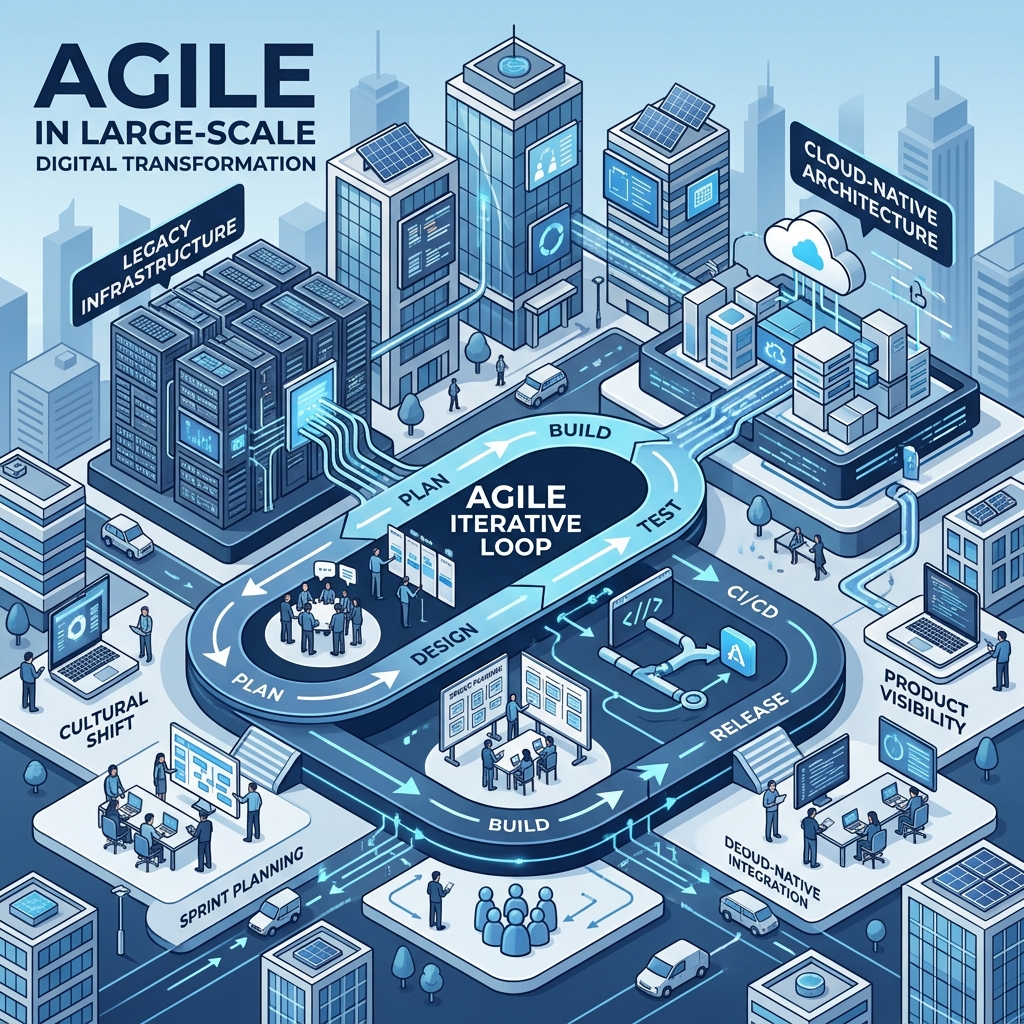
A common misconception is that Agile necessitates a lack of architectural discipline. On the contrary, large-scale Agile requires a robust 'Architectural Runway'. This involves building out the necessary infrastructure, data standards, and security protocols ahead of the feature teams to ensure that iterative delivery doesn't lead to 'Spaghetti Architecture'. At TAPOSYS, we advocate for the 'Agile Architecture' approach. This means:The Agile Feedback Loop: A Visual Overview
Scaling Agile: Navigating the Cultural and Operational Challenges
While the technical benefits are clear, the human and operational challenges of scaling Agile across a global enterprise are significant. It requires a fundamental shift in mindset—moving from a 'Fixed Mindset' focused on tasks to a 'Growth Mindset' focused on outcomes.1. Breaking Down Silos
Large-scale transformation often gets bogged down in departmental silos. Cross-functional Agile teams, comprising architects, developers, security experts, and business analysts, ensure that everyone is working toward a unified definition of success.2. Managing Configuration Drift
In a rapid, iterative environment, 'Configuration Drift'—where development, staging, and production environments diverge—can become a serious issue. Implementing automated governance and standardising on Azure Resource Manager (ARM) templates or Bicep is essential for maintaining consistency at scale.3. Implementing FinOps for Agile
Agile delivery can lead to rapid cloud resource consumption. Integrating FinOps practices into the Agile lifecycle ensures that teams are aware of the financial impact of their architectural decisions, preventing 'Cloud Sprawl' and ensuring optimal ROI on the transformation budget.The TAPOSYS Perspective: Boutique Agile for Global Enterprises
At TAPOSYS Global IT Solutions LLP, we don't just 'do' Agile; we engineer it into the very fabric of the transformation journey. Our methodology focuses on combining the speed of start-up agility with the governance and architectural rigour required by Fortune 500 enterprises. We specialise in Application Modernisation and AI Engineering using an 'Agile-First' approach, ensuring that our clients' digital cores are not just updated, but future-proofed. The journey of large-scale digital transformation is complex, but with the right Agile framework and architectural leadership, it is entirely navigable. By prioritising visibility, incremental value, and architectural integrity, organisations can transform their legacy constraints into a competitive digital advantage.Key Takeaway
Agile is the 'glue' that binds strategic vision to technical execution in a large-scale digital transformation. To succeed, enterprises must move beyond superficial Scrum adoption and embrace deep, top-to-bottom agility that includes architectural governance, automated DevOps, and proactive cost management (FinOps). --- Follow the TAPOSYS Lead Architect for more daily technical deep-dives into the future of enterprise technology.
The TAPOSYS Perspective
Our architecture-first methodology ensures that every digital transformation initiative is rooted in absolute scalability and long-term security. We don't just build systems; we engineer future-proof legacies.