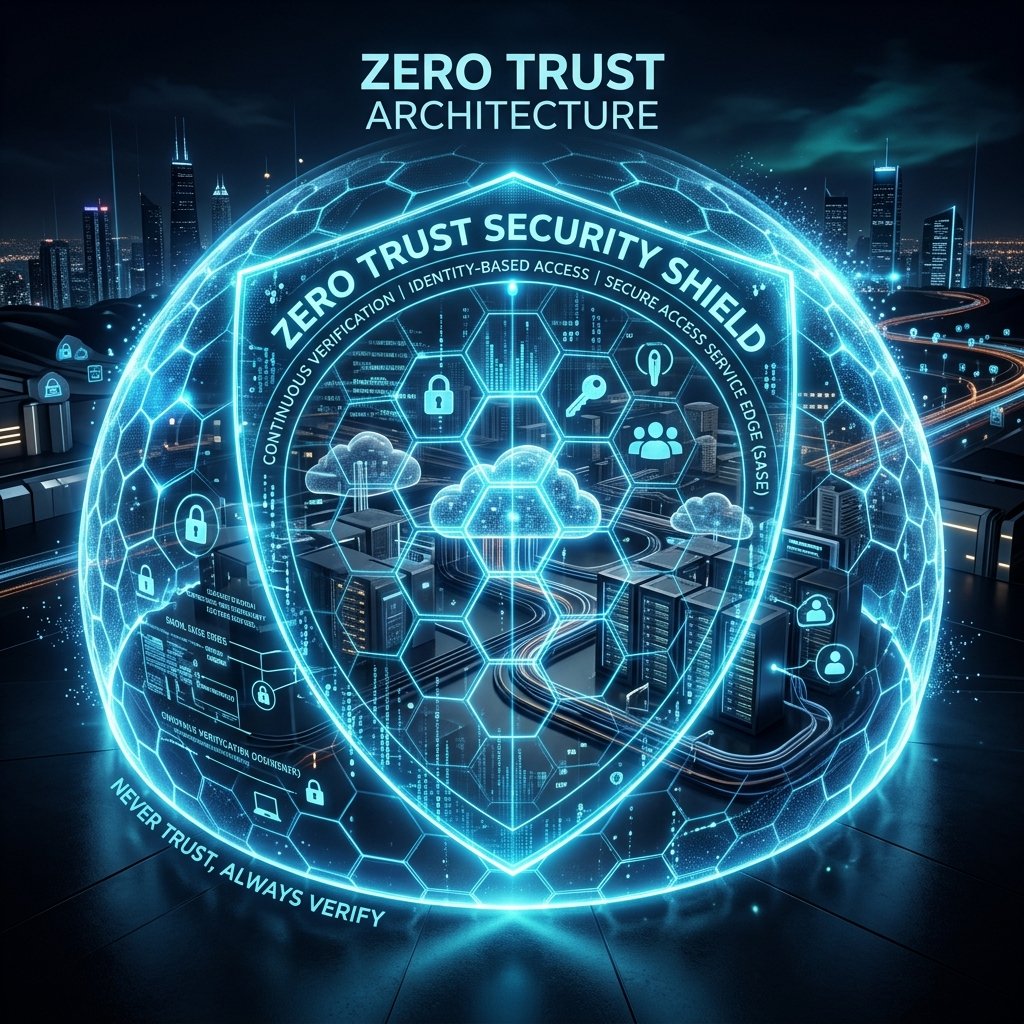
Zero Trust in Hybrid Environments: Securing the Perimeter-less Enterprise
"A deep-dive into the architectural principles of Zero Trust security, focusing on identity verification, least privilege access, and securing hybrid cloud infrastructures."
Zero Trust in Hybrid Environments: Securing the Perimeter-less Enterprise
The traditional "Castle and Moat" security model—where everything inside the corporate network is trusted and everything outside is not—is dead. In a world of remote work, multi-cloud environments, and edge computing, the perimeter has dissolved. For the Lead Digital Architect, the new mandate is simple but profound: Never Trust, Always Verify. This is the core of Zero Trust Architecture.
"Zero Trust is not a product you buy; it is a philosophy you build. It assumes that the threat is already inside the network and requires every request to be fully authenticated, authorised, and encrypted." — TAPOSYS Architectural Insight
The Three Pillars of Zero Trust
Zero Trust relies on three fundamental principles that must be applied across every layer of your Infrastructure Management (IMS) strategy.
1. Verify Explicitly
Every access request must be validated against all available data points. You no longer grant access based on being "on the VPN" or in a specific office.1. Identity-First Security: Use Microsoft Entra ID (formerly Azure AD) as your central identity provider. Implement Multi-Factor Authentication (MFA) as a non-negotiable requirement for all users. 2. Conditional Access: Define policies that evaluate the risk of a login in real-time. Is the user on a managed device? Are they connecting from an unusual location? If the risk is high, block access or require additional verification. 3. Device Health Attestation: Only allow "healthy," compliant devices to access sensitive corporate data. If a laptop is missing a security patch, it should be quarantined from the network.
2. Use Least Privilege Access
Limit user and service access to only what is strictly necessary for the task at hand. This is known as "Just-In-Time" and "Just-Enough" Access (JIT/JEA).1. Privileged Identity Management (PIM): Do not let users have permanent admin rights. Require them to "activate" their roles for a specific duration, with an approval workflow and full audit trail. 2. Micro-Segmentation: Break your network into small, isolated segments. If a single web server is compromised, the attacker should be blocked from moving laterally to the database or the digital core. 3. Service Identity: Apply the same Zero Trust principles to applications. Use Managed Identities in Azure to allow services to talk to each other without ever needing to manage or store credentials in code.
3. Assume Breach
Architect your systems with the mindset that a compromise has already occurred. This shifts the focus from prevention to detection and containment.1. End-to-End Encryption: Encrypt all data, both at rest and in transit. Even if an attacker intercepts traffic, the data must be unreadable. 2. Continuous Monitoring with AIOps: Use AI-driven security tools like Microsoft Sentinel to analyse billions of signals across your hybrid environment, identifying anomalies that human analysts might miss. 3. Automated Incident Response: When a threat is detected, your system should be able to automatically revoke access, isolate the affected resource, and trigger an alert for the security team.
"The strength of your Zero Trust architecture is measured by how effectively it contains a breach, not just how well it blocks one."
Executive Zero Trust Checklist
The TAPOSYS Perspective: Security-First Architecture
At TAPOSYS Global IT Solutions LLP, we integrate Zero Trust into the foundation of every project. Whether we are building a Cloud Engineering environment or managing your Application Portfolio (AMS), security is never an afterthought. Our "Security-First Engineering" methodology ensures that your hybrid infrastructure is resilient against the most sophisticated modern threats. We don't just protect your data; we protect your business's ability to innovate safely.Key Takeaway
Zero Trust is the only viable security model for the modern, perimeter-less enterprise. By verifying explicitly, enforcing least privilege, and assuming breach, organisations can build a resilient infrastructure that enables digital transformation without increasing risk.--- Ready to secure your enterprise? Explore our Infrastructure Management and Cloud Security services at TAPOSYS Global.

The TAPOSYS Perspective
Our architecture-first methodology ensures that every digital transformation initiative is rooted in absolute scalability and long-term security. We don't just build systems; we engineer future-proof legacies.