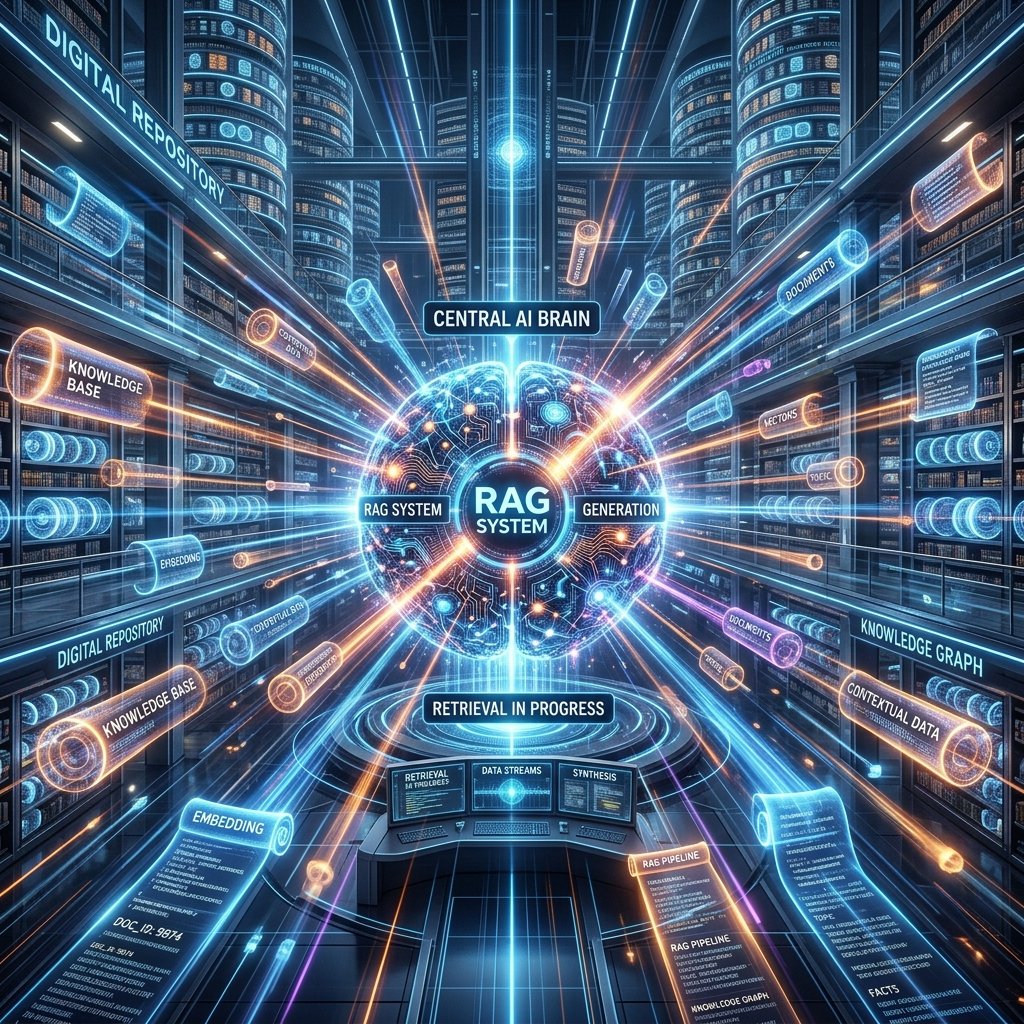
Enterprise RAG Systems: Scaling Knowledge Retrieval with Vector Databases
"A deep-dive into Retrieval-Augmented Generation (RAG) for the enterprise. Learn how to architect scalable, secure, and accurate AI systems that leverage your private corporate knowledge."
Enterprise RAG Systems: Scaling Knowledge Retrieval with Vector Databases
For a Large Language Model (LLM) to be useful in an enterprise context, it must know your business. A standard GPT model knows the world, but it doesn't know your specific product manuals, your internal HR policies, or your historical project data. This is where Retrieval-Augmented Generation (RAG) comes in. For the Chief Content Officer, RAG is the architecture that transforms a "generic AI" into a "corporate oracle." This is the most critical workflow in modern AI Engineering.
"RAG is the process of giving an AI a library before you ask it a question. It ensures that the model's answers are grounded in your facts, not its hallucinations." — TAPOSYS Architectural Insight
The RAG Architectural Blueprint
A robust enterprise RAG system is more than just a search engine; it is a complex pipeline that involves data ingestion, embedding, retrieval, and generation.
1. The Ingestion and Embedding Pipeline
Before the AI can search your data, the data must be translated into a language the machine understands: Vectors (mathematical representations of meaning).1. Document Chunking: Break large documents (PDFs, Wikis, Word docs) into smaller, semantically meaningful "chunks." If a chunk is too large, the meaning is lost; if it's too small, the context is missing. 2. The Embedding Model: Use models like OpenAI's `text-embedding-3-small` or Azure's equivalents to convert text chunks into high-dimensional vectors. 3. Vector Databases: Store these embeddings in a specialized database like Azure AI Search, Pinecone, or Milvus. These databases are designed for "similarity search," finding the content that is most relevant to a user's query based on meaning, not just keywords.
2. The Retrieval and Ranking Strategy
When a user asks a question, the RAG system must find the most relevant "library books" (chunks) to give to the LLM.1. Semantic Search: The system converts the user's question into a vector and finds the closest matches in the vector database. 2. Hybrid Search: Combine semantic search (meaning) with traditional keyword search (exact matches for technical terms or product IDs). This ensures the highest accuracy for enterprise-specific jargon. 3. Re-Ranking: Use a secondary, "heavier" model to look at the top results and pick the absolute best ones. This filters out "near misses" that might confuse the LLM.
3. The Generation and Grounding Phase
The final step is to package the retrieved chunks and the user's question into a single "Prompt" for the LLM.1. System Prompting: Tell the LLM: "Answer this question only using the provided context. If the answer isn't there, say you don't know." This is the primary defence against AI hallucinations. 2. Citation Mapping: Ensure the AI cites its sources (e.g., "According to page 4 of the 2024 Policy Guide..."). This builds trust with human users and allows for easy verification. 3. Privacy and Security: Ensure the retrieval layer respects user permissions. A user in Marketing should not be able to "retrieve" data from a private HR document via the AI.
"An enterprise RAG system is only as good as its data quality. If your internal documentation is a mess, your AI will be confidently wrong."
Executive RAG Implementation Checklist
The TAPOSYS Perspective: Architecting Knowledge Sovereignty
At TAPOSYS Global IT Solutions LLP, we specialise in building "Sovereign AI" environments. We understand that your corporate knowledge is your most valuable asset. Our AI Engineering team focuses on building RAG systems that are secure, accurate, and deeply integrated with your Infrastructure (IMS) and Digital Core. We don't just build chatbots; we build intelligent knowledge engines that empower your workforce to find the right information in seconds.Key Takeaway
RAG is the essential architecture for making AI "enterprise-ready." By grounding LLMs in your private corporate data through vector search and rigorous grounding, you transform AI from a creative novelty into a high-precision tool for business intelligence and operational efficiency.--- Ready to unlock your corporate knowledge? Explore our AI Engineering and Data Transformation services at TAPOSYS Global.

The TAPOSYS Perspective
Our architecture-first methodology ensures that every digital transformation initiative is rooted in absolute scalability and long-term security. We don't just build systems; we engineer future-proof legacies.